
Frequently Asked Questions about Spring-Loaded Pogo Pins & Connectors
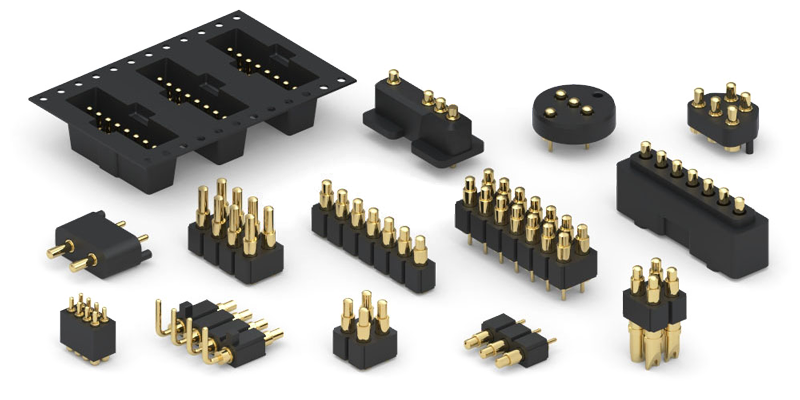
Mill-Max spring-loaded pogo pins provide reliable electrical connections for board-to-board, blind-mate, docking, charging, testing and modular interconnect applications. These FAQs explain how pogo pins work, available mounting and plunger styles, stroke, compression, current, cycle life, mating targets, environmental considerations and custom options.
- What are Spring Loaded Pogo Pins?
- How are spring-loaded pogo pins constructed?
- How do Spring-Loaded Pins work?
- What are the benefits of using spring-loaded pogo pins?
- What are Spring-Loaded Pins used for?
- What styles of spring-loaded pogo pins are available?
- What should engineers consider when selecting a spring-loaded pogo pin?
- What is the maximum stroke Mill-Max spring-loaded pins can provide?
- What is the recommended compression/travel range for Mill-Max spring-loaded pins?
- How many cycles are Mill-Max spring-loaded pins tested to?
- What is the highest current-rated spring-loaded pin Mill-Max can offer?
- Are there alternative plunger styles for Mill-Max spring-loaded pins?
- Can I Swap the Spring in My Spring-Loaded Contact?
- How are spring-loaded pogo pins mounted?
- What are mating targets for spring-loaded pogo pins?
- Can Mill-Max spring-loaded pins mate with a dedicated pad on the opposing surface?
- Are Mill-Max spring-loaded pins sealed or waterproof?
- Can Mill-Max spring-loaded pins be subjected to washdown procedures?
- Are Mill-Max spring-loaded pins or connectors lubricated?
- Are Mill-Max spring-loaded pins and connectors available on tape and reel?
- Do spring-loaded pins on tape and reel require a pick-and-place cap?
- Are 3D models of Mill-Max spring-loaded products available?
- Can Mill-Max spring-loaded pins be customized?
-
What are Spring Loaded Pogo Pins?
Mill-Max spring-loaded pins, also known as spring-loaded contacts or pogo pins, provide an alternative interconnect solution for transmitting electrical signals and power through their contact points. Mill-Max’s spring-loaded pins consist of a precision-machined plunger, body, and cap, along with an internal spring which provides a range of mechanical movement when assembled. Mill-Max offers many options for spring-loaded pins that incorporate different stroke lengths, diameters, overall heights and spring forces. Due to Mill-Max’s precision machining capabilities and extremely tight tolerances, a highly durable electrical connection can be achieved.
-
How are spring-loaded pogo pins constructed?
A typical Mill-Max spring-loaded pin consists of four key components: a precision-machined plunger, body and cap, along with an internal spring. The plunger moves within the body as the pin is compressed, while the spring supplies the force needed to maintain electrical contact with the mating surface. The machined components and internal spring are gold-plated to support low contact resistance, durability and corrosion protection. -
How do Spring-Loaded Pins work?
In a spring-loaded pin application, the plunger engages with a mating target contact and creates a surface pressure connection. As the spring is compressed and force is applied, the plunger moves inside the body. The primary path of travel is through the gold-plated outer components, and the electrical interconnect relies on the force of the internal spring to maintain contact between the plunger and the mating component. As the plunger is compressed further, spring force increases, helping maintain a reliable electrical connection with the mating surface.
-
What are the benefits of using spring-loaded pogo pins?
Spring-loaded pogo pins provide a compact, compliant connection that can accommodate stack-up tolerances and minor positional variation. Their spring force maintains contact with the mating surface during compression, while precision-machined, gold-plated components support low resistance, corrosion resistance and long mechanical life. Depending on the selected product, Mill-Max spring-loaded pins are tested for 100,000 to 1,000,000 cycles and are available for board-to-board, blind-mate, docking, charging, testing and modular interconnect applications. -
What are Spring-Loaded Pins used for?
Spring-loaded pins can be used in many electrical interconnect applications. Mill-Max offers spring-loaded pins in multiple configurations and stroke options which can be beneficial in applications with large stack-up tolerances. Spring-loaded pins are ideal for blind mating applications as the only connection required is for the plunger to engage with a mating target contact or contact pad. Whether the spring-loaded pin application is a simple board-to-board interconnect, or a more modular connection, Mill-Max has spring-loaded pins for your application.
-
What styles of spring-loaded pogo pins are available?
Mill-Max offers discrete spring-loaded pins and connector assemblies in surface-mount, through-hole, press-fit, wire-termination and horizontal configurations. Options include low-, standard- and high-force springs; insulated and double-action contacts; large-base and higher-current designs; connector arrays; tape-and-reel packaging; magnetic Maxnetic® connectors; and Omniball® rolling contacts for sliding, rotating or off-axis engagement. -
What should engineers consider when selecting a spring-loaded pogo pin?
Engineers should evaluate available space, initial height, maximum stroke, recommended working travel, current rating, spring force, contact resistance, cycle-life requirement, termination method, mating-surface geometry and environmental conditions. Mill-Max generally recommends operating spring-loaded pins at or near rated travel, typically mid-stroke, for optimal electrical and mechanical performance. Operating close to full compression can reduce mechanical life, and conventional plunger-style contacts should normally be loaded axially rather than from the side. -
What is the maximum stroke Mill-Max spring-loaded pins can provide?
Mill-Max offers standard spring-loaded pins with up to .118” (3 mm) of maximum stroke.
-
What is the recommended compression/travel range for Mill-Max spring-loaded pins?
Mill-Max recommends their spring-loaded pins operate at mid-stroke compression for optimal electrical and mechanical performance.
-
How many cycles are Mill-Max spring-loaded pins tested to?
Most Mill-Max spring-loaded pins are tested for 100,000 to 1,000,000 cycles at the recommended mid-stroke compression.
-
What is the highest current-rated spring-loaded pin Mill-Max can offer?
Mill-Max offers discrete spring-loaded pins with a maximum current rating of 13 A and a 20% derated current rating of 10.4 A. The derated rating provides a safety margin below the maximum current. For more information, see our Application Note,
-
Are there alternative plunger styles for Mill-Max spring-loaded pins?
Most of Mill-Max’s spring-loaded pins have a plunger with a radius on the tip, however, we can also provide flat and pointed tip plungers as an alternative option for most spring-loaded pins.
-
Can I Swap the Spring in My Spring-Loaded Contact?
Yes, for certain spring families. Mill-Max offers compatible spring options within the following spring groups, allowing you to change spring force without changing the overall contact design:
- 50 ↔ 80 Series Springs
- 72 ↔ 75 ↔ 87 Series Springs
- 62 ↔ 82 Series Springs
- 63 ↔ 83 Series Springs
These spring families share compatible dimensions, making it possible to substitute one spring for another to achieve a different operating force.
Before selecting a replacement spring, review the Internal Spring Selection & Performance Guide to compare force curves, travel characteristics, and performance specifications.
Not all springs in each group are interchangeable. Contact an applications engineer to determine interchangeability.
-
How are spring-loaded pogo pins mounted?
The correct mounting method depends on the application and selected part. Mill-Max spring-loaded pins are available with surface-mount, through-hole mount, solder-cup and crimp wire termination features, and they can also be supplied in connector housings or custom arrays. Engineers should use the mounting dimensions, recommended PCB layout and assembly instructions shown on the applicable product page or datasheet rather than applying one general mounting method to every pin. -
What are mating targets for spring-loaded pogo pins?
A mating target is the conductive surface contacted by the spring-loaded plunger. A spring-loaded pin may mate directly with a plated PCB land or conductive pad, or with a dedicated target pin, target disc or target connector. Mill-Max target products are available with flat or concave faces and with surface-mount, through-hole and wire-termination options. -
Can Mill-Max spring-loaded pins mate with a dedicated pad on the opposing surface?
Mill-Max spring-loaded pins can mate with any conductive surface. For optimal electrical and mechanical performance, we recommend mating against our dedicated target contacts and target discs.
-
Are Mill-Max spring-loaded pins sealed or waterproof?
Mill-Max spring-loaded pins are not IP-rated but they have been used in waterproof/IP-rated applications. A typical Mill-Max spring-loaded pin consists of four key components: a precision-machined plunger, body and cap, along with an internal spring. When a spring-loaded pin is compressed, the plunger will move inward, residing inside the pin’s connector body. This movement will create an entry point for liquids or contaminants. For waterproof applications, Mill-Max spring-loaded pins can be installed into their own sealed housing that utilizes gaskets or O-rings to create a sealed environment for the pins to function. For more information, contact us.
-
Can Mill-Max spring-loaded pins be subjected to washdown procedures?
While we do not provide any formal guidelines regarding washing down of our parts, we are aware of customers who have successfully performed this type of operation by using mild cleaning solutions, such as soap and deionized water. If your application requires the use of more aggressive cleaning solutions or procedures, we suggest testing the proposed cleaning process to ensure that it does not damage the spring-loaded pin or the gold plating finish. Avoid using solutions that leave a residue that may hinder the movement of the plunger and/or internal spring.
-
Are Mill-Max spring-loaded pins or connectors lubricated?
Mill-Max spring-loaded connectors are not lubricated. Customers have successfully used light-viscosity oils in some applications. Typical applications do not require lubrication.
-
Are Mill-Max spring-loaded pins and connectors available on tape and reel?
Most discrete spring-loaded pins can be packaged on tape and reel. Some factors that determine whether a part is suitable for tape-and-reel packaging include overall length, largest diameter and retention features.
Some Mill-Max spring-loaded connectors are available on tape and reel with a pick-and-place clip.
-
Do spring-loaded pins on tape and reel require a pick-and-place cap?
Most spring-loaded pins are suitable for automatic pick-and-place assembly when a suitable pick-and-place nozzle is used. Mill-Max also offers several series with a removable pick-and-place cap to aid with automated assembly.
-
Are 3D models of Mill-Max spring-loaded products available?
STEP models for most Mill-Max products are available for download directly from the applicable product page. Select “I Want To,” followed by “Download 3D Model.”
-
Can Mill-Max spring-loaded pins be customized?
It is possible to modify existing Mill-Max spring-loaded pin designs or create completely new designs upon review for manufacturing feasibility. Most Mill-Max spring-loaded pins consist of four key components: a precision-machined plunger, body and cap, along with an internal spring. Custom discrete spring-loaded pins have a minimum order quantity of 1,000 pieces. An NRE charge may apply when a new spring or new machined component is required. For more information, view our Custom Capabilities.
Still have a question we did not answer here?
Sealing, washdown, current derating, plunger styles, tape and reel: the specifics usually depend on your application. Ask our engineers directly, or review what is involved in modifying an existing design.